The Arrow Fitting Kit
The FireArcher method for fitting target arrows to the archer and the bow: your draw, the arrow's length, the weight you really pull, and the spine band that follows from all three
FireArcher's Arrow Spine Calculator asks for the draw weight at your draw length and the full length of your arrow. The Draw Length and Draw Weight Calculators supply those two numbers, but they sit on separate pages, and most archers type the weight printed on the limbs (rated at a 28 in draw) and a 28 in arrow, because that is the chart's reference line. That reads the chart weak, and weaker is the risky direction: an arrow too weak for the bow flexes too far on release, and a weak or damaged shaft can break and injure the archer. The Arrow Fitting Kit chains the site's tools. Its worked archer has a 72 in wingspan, a 28.8 in draw and an arrow cut 1 in past it at 29.8 in; limbs marked 34 lb pull 35.36 lb at that draw, and the whole setup reads 44.4 lb on the chart, a 500 spine. The limb label and a 28 in arrow read 700, two bands weaker. The kit takes that band to the arrow maker's chart and a pro shop, takes the stiffer band near an edge, checks the balance (a heavier point moves the spine too: 150 gr crosses the example into 400), and proves each change on the score sheet, one change at a time. Target archery only. Every worked figure is an example you replace with your own, and rules of thumb are called rules of thumb. The kit carries the safety facts: never dry-fire a bow, flex and inspect every arrow before each shot, shoot only at a safe backstop and never at people or animals, follow the range whistle, and start beginners and children at a light draw weight with a coach. You get a 23-page printable PDF with seven steps, fitting cards, a score log, an arrow check log, reference tables and a quickstart, plus a personalised sheet worked out from the numbers you entered in our calculators.
Look inside
Two full pages from the kit, exactly as printed. Click either to read it at full size before you decide.
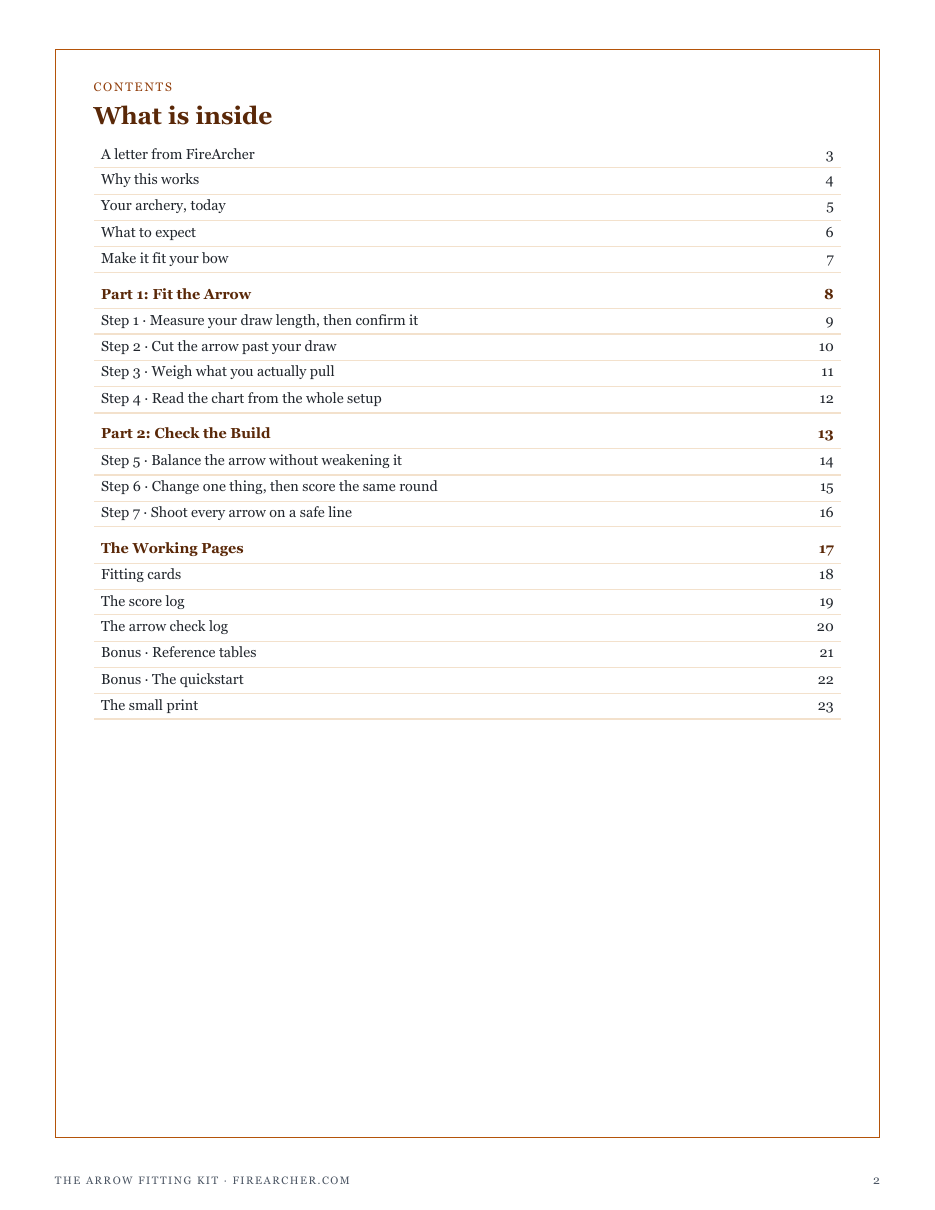
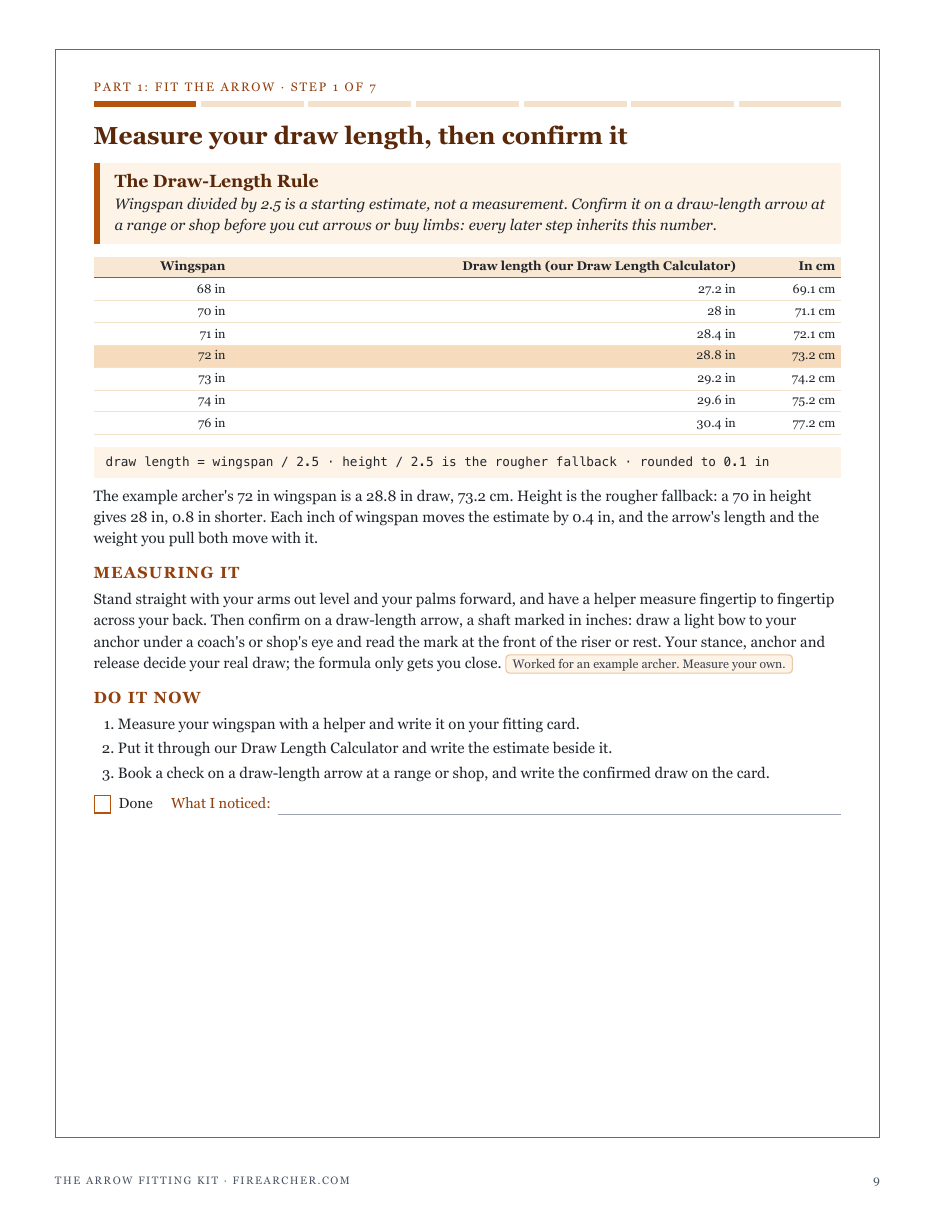
What is in it
- The Draw-Length Rule: wingspan divided by 2.5 as a starting estimate, and confirming it on a draw-length arrow
- The Clearance Rule: cutting the arrow at least 1 in past your draw, and what each extra inch does on the spine chart
- The Label Rule: the weight you actually pull at your draw, against the weight marked at 28 in
- The Stiffer-Side Rule: reading the spine chart from the whole setup, the shortcuts that read it weak, and the maker's chart
- The Point Rule: point weight, FOC and the balance point for 7 to 15 percent, without weakening the arrow
- The One-Change Rule: one change at a time, the same round, and the score per arrow before and after
- The Safe Line Rule: never dry-fire, the flex test before each arrow, safe backstops and the range whistle
- Printable fitting cards, a score log and an arrow check log
- Reference tables: weight pulled by marked weight and draw, and the chart's band by weight and arrow length
- A quickstart that closes the loop on your starting scores
- ✓ 23 printable pages
- ✓ 10 sections, worksheets and templates
- ✓ A second PDF worked out from the numbers you enter
- ✓ No account needed, just an email address
- ✓ Instant download; link valid 7 days
Price includes any taxes. Sold by GrabURL, who handle checkout and support. The charge appears on your statement as GrabURL.
The kit picks up where the free Arrow Spine Calculator leaves off. It asks for the draw weight at your draw length and the full length of your arrow; most archers type the weight on the limbs and a 28 inch arrow, and read the chart weak. The kit chains the Draw Length Calculator and the Draw Weight Calculatorinto it: your draw, confirmed; an arrow cut past it; the weight you actually pull; the spine band the whole setup reads, taken to the arrow maker's chart and a pro shop; then balance, the one-change score test and the safe line. It carries the safety facts: an arrow too weak for the bow can break on release, so never shoot one; never dry-fire a bow; flex and inspect every arrow for cracks before you shoot it; shoot only at a safe backstop, never at people or animals, and follow the range whistle; and beginners and children start at a light draw weight, with a coach. Target archery only. The worked figures are examples; your own measurements replace them.